Speculative technology
PhotonBoard: What If Light Could Carry Us?
A speculative hoverboard powered by light turns real photon physics into a thought experiment about impossible engineering, product storytelling, and future mobility.
By Laurens De Leeuw · Digital Solutions Architect · Published · Last updated · Technically verified · 7 min read
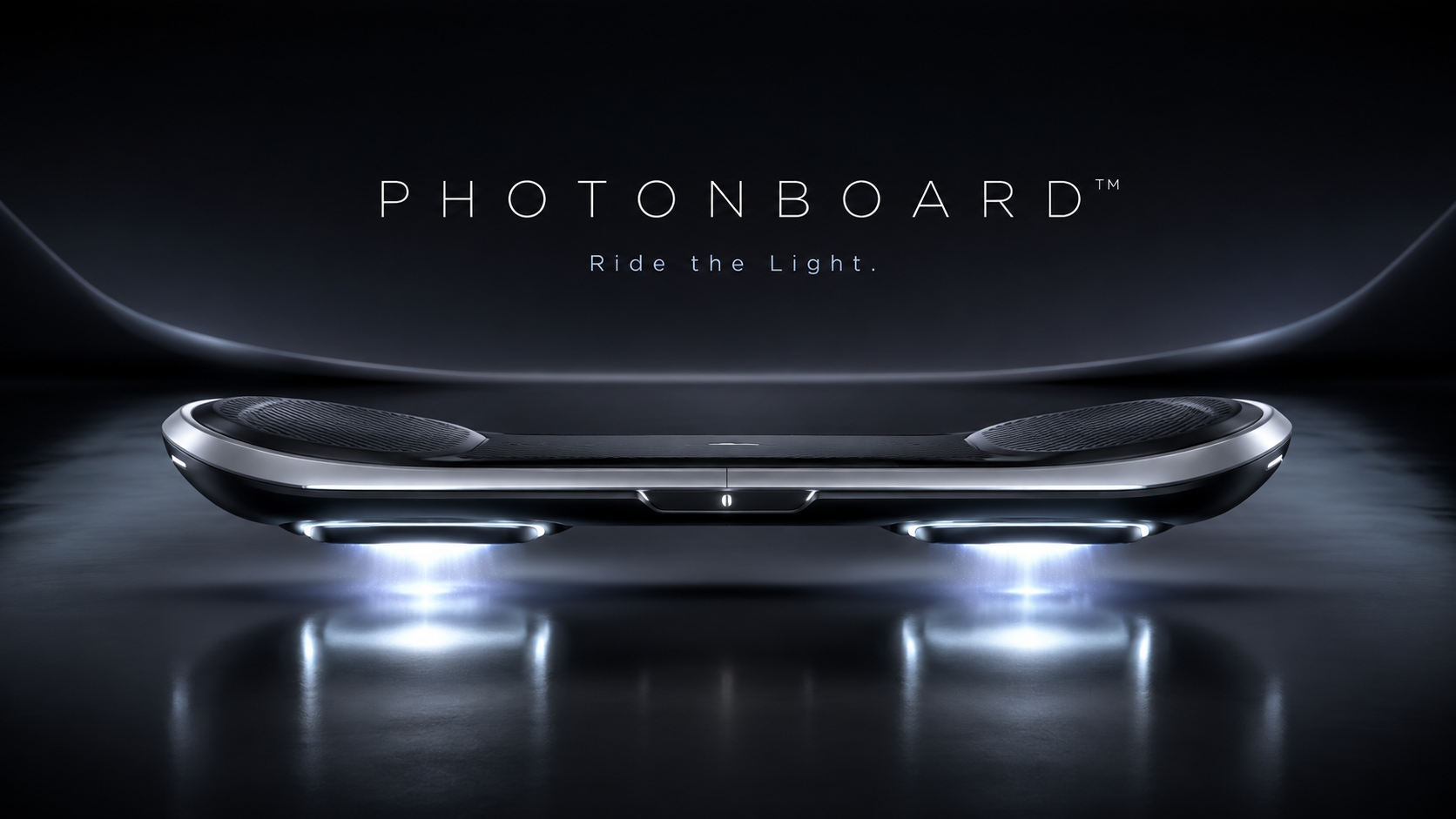
Concept note: PhotonBoard™ is a fictional, speculative mobility concept. It is not a real product, engineering prototype, or announced technology. Its performance figures and “ground-interface field” are fictional. The real physics below shows where the thought experiment begins and where it deliberately leaves current engineering behind.
Wheels are ancient. Roads are optional. Gravity is negotiable.
That was the opening of my launch-style PhotonBoard post on LinkedIn. The premise is simple: remove the most basic assumption behind personal transport, then imagine what replaces it.
Most mobility concepts begin with a familiar machine and improve it. Add a lighter frame, a larger battery, a more efficient motor, or better suspension. PhotonBoard starts somewhere else.
No wheels. No rails. No physical contact with the road. Instead, the fictional board imagines light becoming a propulsion system powerful enough to lift a person and carry them across the planet.
It is deliberately impossible with today's technology. That is what makes the question useful:
What would mobility become if the ground no longer dictated how we move?
The PhotonBoard concept
PhotonBoard imagines a personal hoverboard driven by two stellar-density photon projectors mounted beneath its chassis. The emitters direct coherent light downward while a fictional “ground-interface field” recycles momentum through the surface below.
The specifications are intentionally cinematic:
| Feature | Fictional specification |
|---|---|
| Hover height | Up to 1.2 metres |
| Top speed | 1,240 mph |
| Cruising range | 3,800 miles |
| Lift system | Dual stellar-density photon projectors |
| Radiative output | Equivalent to 18 million suns per emitter |
| Forward thrust | Equivalent propulsive output of 42 million suns |
| Ride feel | Smoother than air, sharper than instinct |
None of these figures describes a feasible machine. They describe the emotional scale of the idea.
PhotonBoard is not intended to be another electric skateboard. It is a vision of movement without tyres, pavement dependency, or familiar propulsion hardware. The rider would not roll across the landscape. They would glide above it on controlled momentum carried by light.
The image is simple: one rider, one board, and an engineered storm of photons underneath.
The real physics behind the fiction
The thought experiment begins with something completely real: photons carry momentum.
When light is absorbed by a surface, it transfers momentum. When light reflects, the change in momentum can be twice as large because the photons reverse direction. That produces radiation pressure, a tiny but measurable force.
The principle already moves spacecraft. Solar sails use large, lightweight, reflective surfaces to collect a continuous push from sunlight. The force is small, but in space there is no atmospheric drag and the effect can accumulate over time. NASA's Advanced Composite Solar Sail System pairs a microwave-oven-sized CubeSat with an 80-square-metre sail. The sail needs that area precisely because solar radiation pressure is so slight.
At normal incidence, a perfect mirror has a maximum force-to-optical-power ratio of 2/c, or about 6.67 × 10⁻⁹ newtons per watt, as described in this NIST analysis of radiation-pressure power measurement.
That is where PhotonBoard crosses from physics into fiction.
How much light would hovering require?
Consider a combined rider and board mass of 100 kilograms. Hovering would require an upward force of roughly 981 newtons just to balance gravity.
Under the ideal perfect-reflection limit, producing that force would require approximately:
P = Fc / 2 ≈ 147 gigawatts
A simple onboard emitter firing photons downward gets only F = P/c, so the requirement rises to roughly:
P = Fc ≈ 294 gigawatts
These are illustrative theoretical lower bounds, not practical designs. Real hardware would lose energy through imperfect conversion, beam divergence, absorption, atmospheric scattering, and control inefficiency. Even a tiny fraction of that optical power turning into heat would create an extreme hazard for the rider, the board, and everything below it.
The LinkedIn concept pushes the scale much further. The International Astronomical Union defines the Sun's nominal luminosity as 3.828 × 10²⁶ watts. On that basis, the fictional claim of 18 million suns per emitter equals about 6.89 × 10³³ watts for each projector. That figure, derived from the IAU nominal solar luminosity, is storytelling on a cosmic scale, not an engineering specification.
The other concept numbers bring their own boundaries. Travelling at 1,240 mph in open air means supersonic shock waves, severe aerodynamic loads, heating, noise, and an enormous stopping-distance problem. Stable personal flight would also demand continuous control, redundant lift, obstacle detection, and a safe descent mode.
What about the ground-interface field?
The ground-interface field is the narrative bridge that lets the concept behave differently from an ordinary photon rocket. It imagines momentum being recycled between the board and the planet below.
Photon recycling is a genuine research idea, but only under tightly controlled conditions. NASA has described photonic laser thrusters that bounce photons repeatedly inside a cavity formed by engineered, highly reflective mirrors on paired spacecraft.
An ordinary road, field, or ocean is not that cavity. It is neither a precision mirror nor part of a controlled optical system. There is no established “ground-interface field” in current physics or engineering.
That distinction is important:
- Photon momentum is real.
- Radiation pressure is real.
- Solar-sail propulsion is real.
- Photon recycling in controlled optical cavities is an area of research.
- Compact projectors lifting a consumer hoverboard are not currently feasible.
- The performance figures and ground-interface field are fictional.
The real science gives the concept a launch point. The fiction gives it permission to travel somewhere unexpected.
What the thought experiment reveals about mobility
Speculative design is useful because it lets us change the constraint before changing the product.
If the brief is “build a better skateboard,” the work will probably focus on wheels, suspension, batteries, and motors. If the brief becomes “make roads optional,” a different set of questions appears.
How would a road-independent vehicle navigate? How would it respond to wind and rain? What happens during a power failure? How would it protect pedestrians? Where could it legally travel? Would cities need lanes, altitude rules, or automated traffic layers? Could rural communities cross terrain that is currently difficult or expensive to connect?
PhotonBoard does not answer those questions. It makes them visible.
It also shows that propulsion is only one part of a believable future product. A real personal flight platform would need:
- Continuous stabilization
- Redundant lift and power
- Obstacle and pedestrian detection
- Emergency descent
- Thermal and acoustic management
- Navigation and traffic coordination
- An interface a rider can trust instinctively
The further a concept travels from familiar technology, the more important those human and system details become.
Why fictional specifications feel real
A speculative product becomes memorable when it is presented with the confidence and precision of a real launch.
A familiar object gives the audience an entry point. A real scientific principle makes the first step plausible. A name creates identity. A silhouette creates recognition. Exact specifications create scale. A tagline creates emotion.
Together, those elements compress an entire imagined future into something people can understand in seconds.
That power comes with responsibility. Fiction should be labelled clearly. Precision can make an imaginary object feel real, especially when the underlying scientific principle genuinely exists. Calling PhotonBoard a speculative concept preserves the excitement without confusing storytelling for engineering evidence.
The goal is not to make anyone believe the board exists. The goal is to make the future vivid enough to discuss.
Ride the idea
PhotonBoard may never exist in this form. Light-based propulsion may remain most valuable where it already has a natural advantage: moving extremely light spacecraft through the vacuum of space.
Still, unreasonable questions can be productive.
What if propulsion required no onboard reaction mass? What if mobility infrastructure became invisible? What if vehicles adapted to terrain instead of forcing terrain to adapt to vehicles? What if our definition of a road changed completely?
PhotonBoard is one answer rendered as a product from another timeline.
Not a forecast. Not a prototype. An invitation to imagine beyond the wheel.
Read the original PhotonBoard launch post on LinkedIn.
Ride the future. Powered by light.